  I. The Child of the White Tree
The wind of the White City carried songs of sorrow and pride — songs of kings long gone and of wars yet to come. In the shadow of the Tower of Ecthelion, on a dawn veiled in silver mist, a child was born to a weary world.
They named him Emrys — “He who remembers the light,” said an old woman who served in the Houses of Healing. The name carried a weight few understood, for the light in Gondor was fading, and those who remembered it were rare as the stars over Mordor.
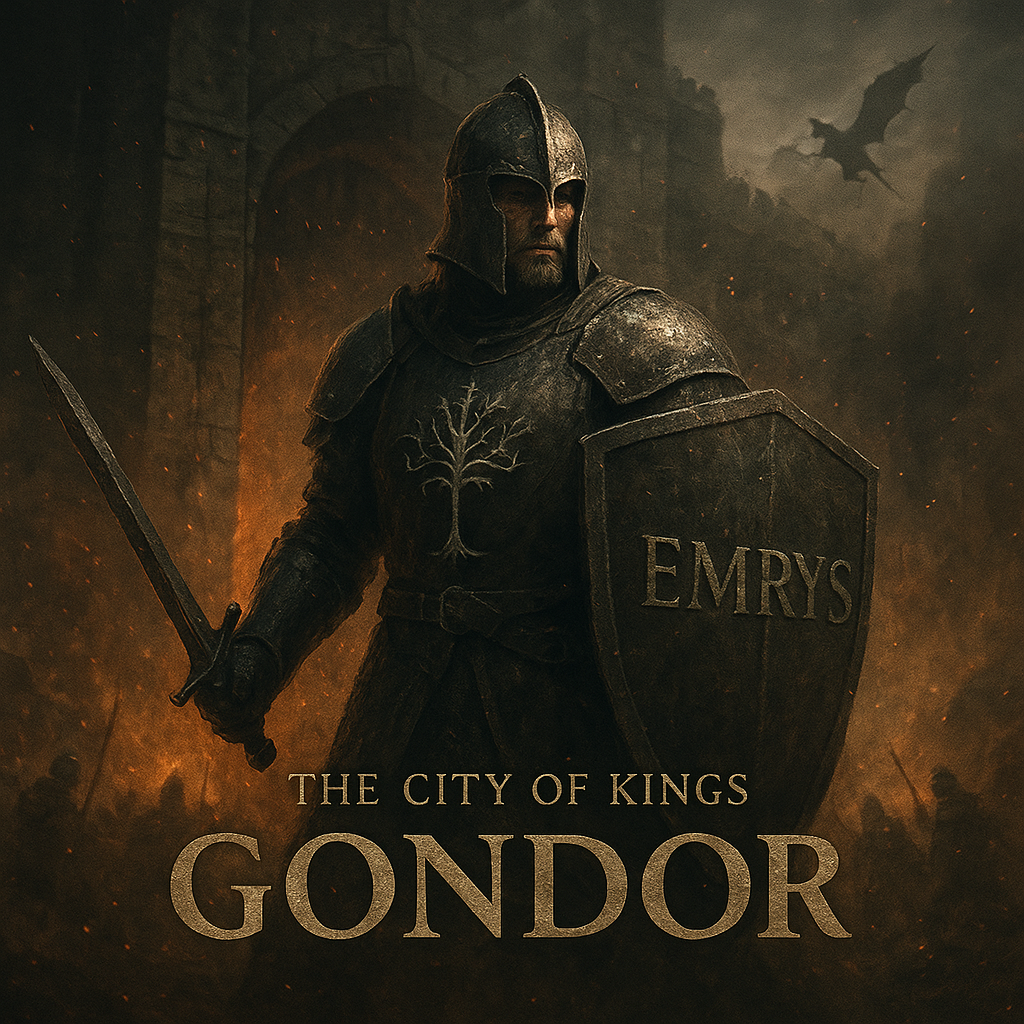
His mother, Alwen, was a healer whose hands smelled of athelas and ash. She moved through the marble halls like a ghost of kindness, tending the wounded soldiers brought back from the frontlines. His father, Carandur, was one of those soldiers — a captain of the second battalion of Osgiliath. He left for war before Emrys could walk, and his return never came. Only his shield — engraved with the White Tree and seven stars — was brought home, cracked, and darkened by fire.
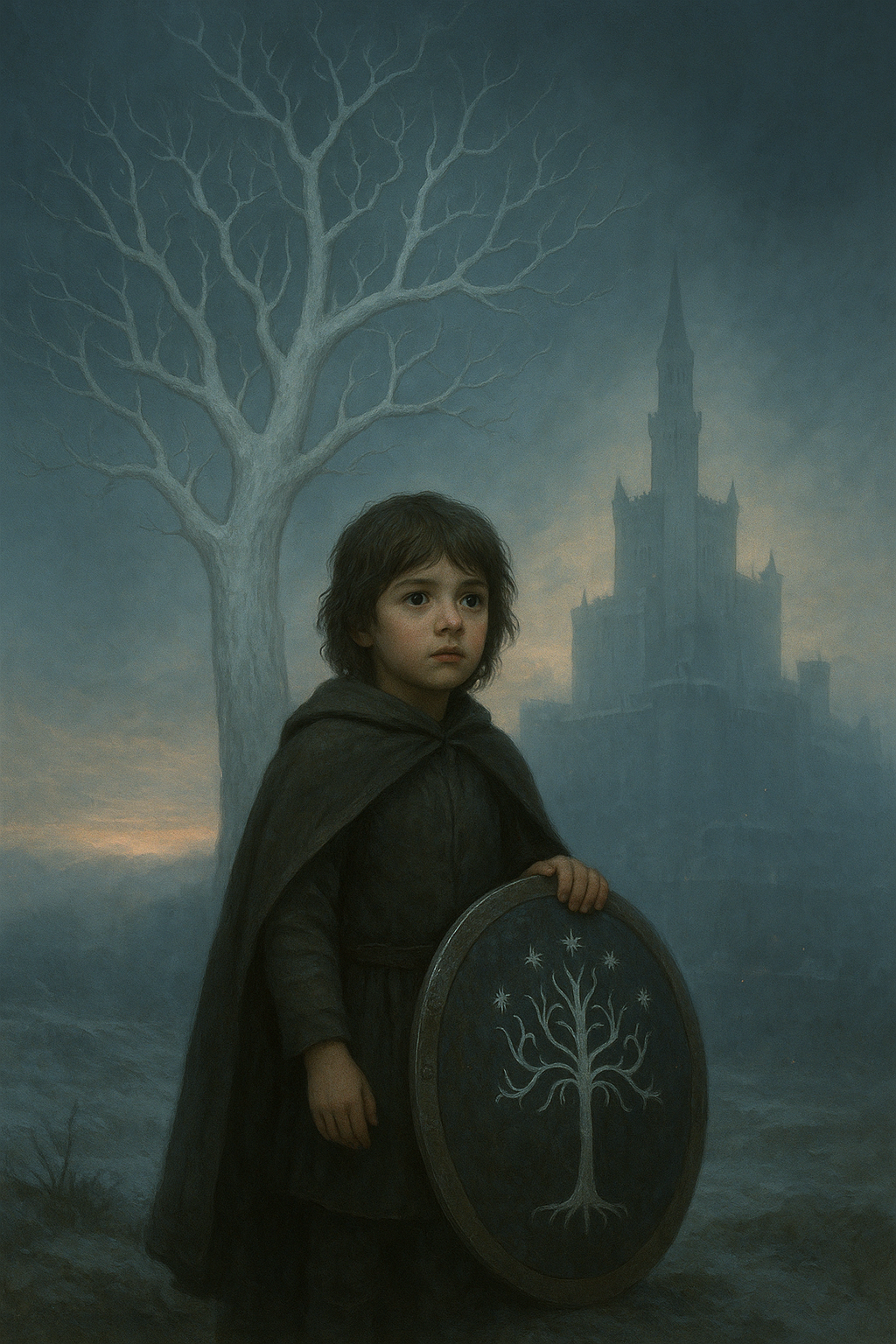
Emrys grew beneath that relic. Every morning before the city awoke, he would polish his father’s shield until his reflection met his gaze. It was as though he sought not his own face, but the face of a legacy.
He was a quiet child. The other boys played with wooden swords and shouted of glory, but Emrys listened. He would sit for hours atop the stone walls of Minas Tirith, watching the Pelennor fields bathe in the light of dawn. He could feel the hum of the city — the heart of Gondor beating beneath the stones, patient and proud.
One winter night, as snow fell silently over the White Tree, his mother found him asleep by the window, the old shield across his lap. The brazier had long gone out, but the boy’s face was calm, almost radiant in the pale moonlight. She whispered a prayer to the Valar that night — not for safety, but for strength. For she knew, as all mothers of Gondor did, that the world would soon demand both.
And so he grew — in a city of marble and memory, beneath a tree that no longer bloomed, yet whose roots reached deep into the bones of kings. And though he was but a boy, sometimes, when the wind blew from the east, he would rise, place his hand on the old shield, and whisper to the dawn:
“I hear you.” II. The Steel of Youth
Years passed like the turning of slow, ancient gears within the White City. The boy who once whispered to the dawn had grown into a young man — quiet, tall, with eyes that carried both the sorrow and the strength of Gondor. His hands bore the marks of labor from the forges, his voice the calm weight of purpose.
Emrys was apprenticed to Talanor, an old swordsmith whose shop stood near the Fifth Gate. The clang of iron became the rhythm of his days, the scent of steel and oil the breath of his youth. Yet what Talanor taught him went far beyond metal — he taught him patience, measure, and the sacred silence between hammer and anvil.
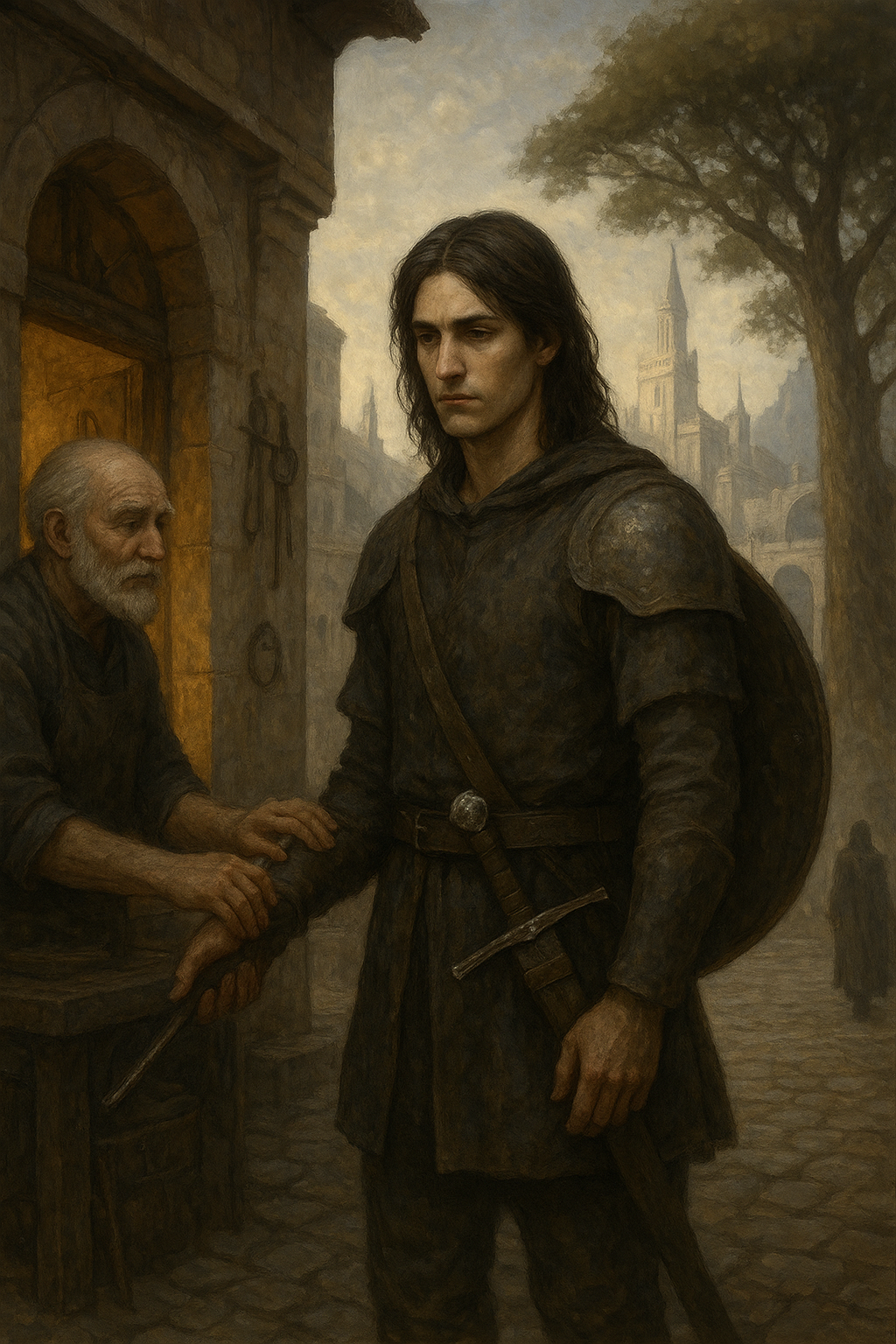
“Steel remembers the hand that shapes it,” the old man would say. “Strike too fast, and it breaks. Strike too soft, and it forgets its purpose. The greatest blades are born from balance — as are men.”
Each night, after the city bells tolled the hour of rest, Emrys would stay behind, forging not for coin, but for understanding. His blades were simple, unadorned — yet they sang when drawn, as if they knew their maker’s heart.
But the peace of the forge could not silence the drums beyond the walls. Dark tidings came from the east — villages burned, riders vanished in the night, the Black Land stirring once more. Gondor began to arm itself. The Great Horn of the City was sounded thrice in one month, and every able man was called to serve.
Emrys did not hesitate. On the day he left, Alwen stood by the gate, her healing robes fluttering in the morning wind. She placed her hand on his cheek, her eyes neither weeping nor proud, but steady — like the roots of the White Tree itself.
“Remember, my son,” she said softly, “the sword does not make you strong. It only reveals what was already there.”
He bowed, pressing his forehead to her hand, and then turned toward the gates of Minas Tirith. The rising sun glinted upon the old shield slung across his back — his father’s shield, mended but not flawless. The scars of old battles gleamed like veins of silver.
When he crossed the threshold, he did not look back. The boy who once dreamed beneath the White Tree was gone. In his place walked a soldier of Gondor — steel in hand, silence in heart, and destiny in his shadow. III. The First Battle
The plains of Ithilien burned beneath a blood-red dawn. Smoke rose from the east like the breath of a waking beast, and the banners of Gondor fluttered against a wind that carried the scent of ash and fear.
Emrys stood among the ranks of fresh recruits — their armor untested, their hearts louder than their courage. The old shield of his father hung heavy on his arm; its weight reminded him of everything he carried — his name, his city, his mother’s quiet strength.
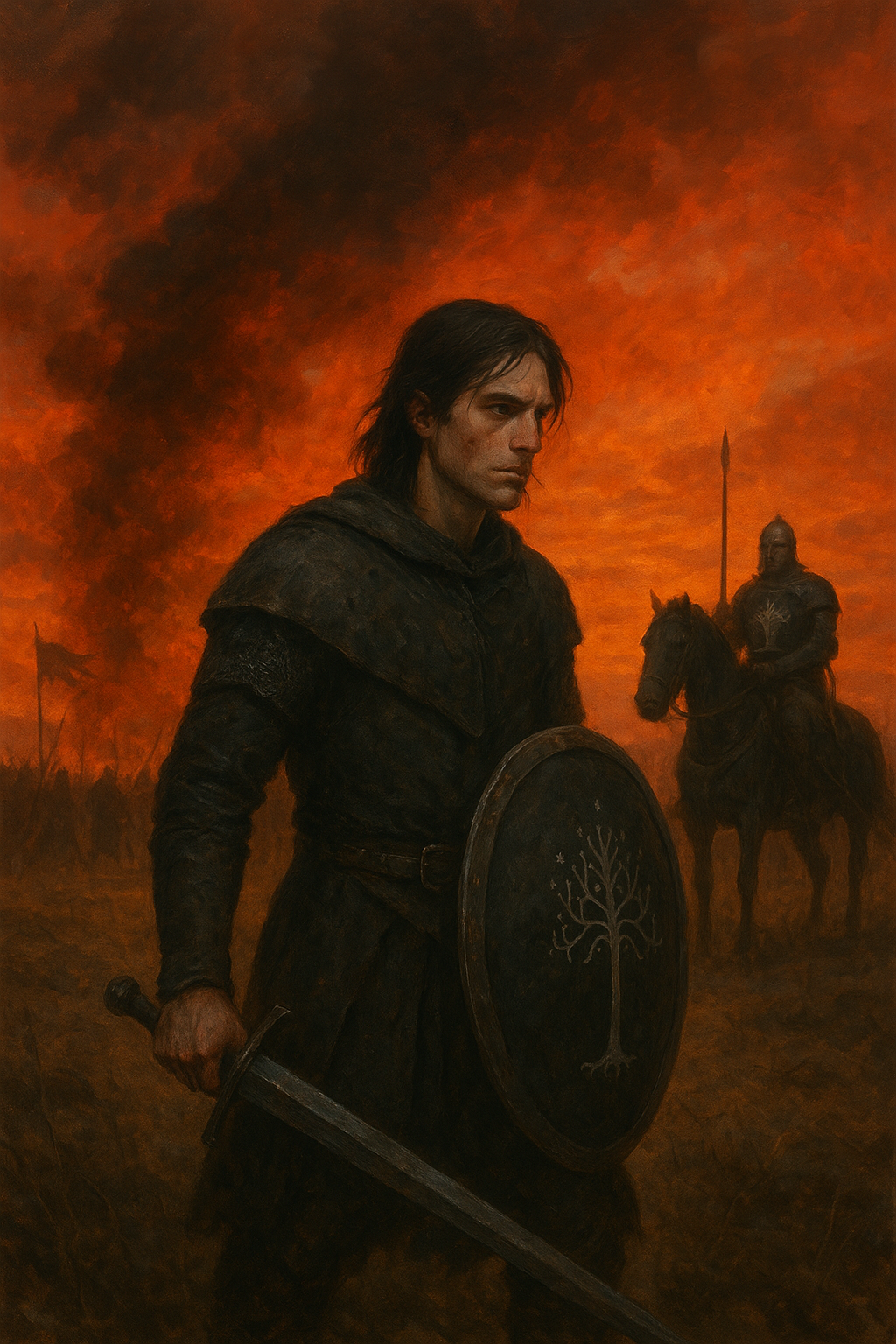
Captain PAPPAS, commander of the southern host, rode along the line. His armor was dark silver, the emblem of the White Tree engraved upon his chestplate. His voice cut through the morning haze:
“Men of Gondor — today, you stand not for glory, but for memory! For every stone that still stands in Minas Tirith, for every name whispered in our halls! Remember who you are!”
The sound of his command filled Emrys’s chest like fire. The horns of battle roared, and the world moved.
They met the enemy at the edge of the Cormallen fields. Orcs poured from the woods — black shapes against the pale light — howling, snarling, endless. The first clash was chaos. Shields cracked, steel screamed, men fell before they even swung.
Emrys’s training vanished. His breath came ragged, his hands shook — and yet, when the first blow struck his shield, instinct took over. He pivoted, countered, and the short sword found its mark. The sound was unlike anything he had ever heard — the wet, final silence of a life ending.
He froze. For a heartbeat, the world seemed still — then an arrow grazed his cheek, and time returned.
He fought until his arms ached and his eyes burned. When the sun dipped behind the hills, Ithilien was painted with blood and smoke. Gondor held the field, but at a price — too many shields lay broken, too many voices silenced.
When the last horn called the retreat, Emrys sank to one knee beside the fallen. His hands, slick with blood not his own, trembled as he looked at the sky — now soft, painted with the dying light.
Captain PAPPAS passed behind him, his horse limping, his gaze sharp and unreadable. He stopped for a moment, rested his hand on Emrys’s shoulder, and said only:
“You did not run. That’s enough for today.”
Emrys did not answer. He simply nodded, eyes fixed on the horizon — the place where light met shadow. And in that silence, something within him hardened — not pride, but purpose.
That night, while others drank or wept, Emrys sat alone by a dying fire, tracing the scars on his shield. The White Tree was chipped, its branches marred, but still it stood.
So would he. IV. The Commander of Gondor — PAPPAS
The years that followed the Battle of Ithilien forged Emrys in ways the forge never could. His silence grew heavier, his strikes more precise, and his gaze — colder. Among the soldiers, he became known not for his words, but for his calm in the storm.
It was during the Siege of Cair Andros that fate crossed his path with Commander PAPPAS, the man whose name was spoken in Gondor with both reverence and fear. PAPPAS was no ordinary captain — he was the embodiment of Gondor’s endurance. His armor bore the mark of countless battles, his voice carried the weight of centuries.
The first time they met, Emrys was dragging a wounded comrade from the burning trenches. PAPPAS dismounted, his silver-plated boots sinking into the mud. He studied the young soldier for a moment — the steadiness in his movements, the controlled fire in his eyes.
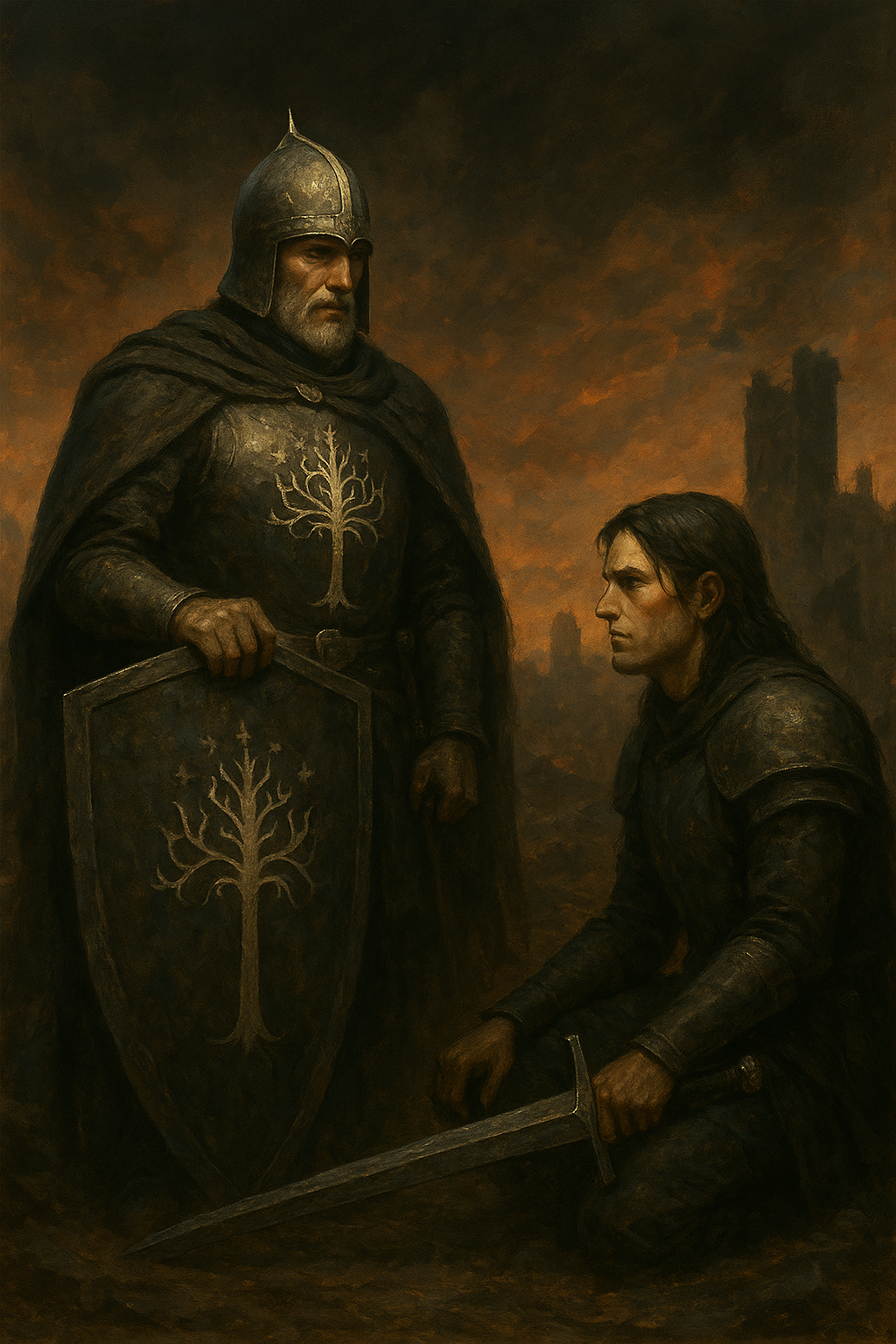
“What’s your name, soldier?”
“Emrys, sir.”
PAPPAS nodded once, slow and deliberate.
“You hold your ground when others break. Gondor needs that more than swords.”
From that day forth, Emrys served directly under PAPPAS. The commander’s strategies were ruthless, but his sense of honor unwavering. He believed that victory was not measured by survival, but by how one stood before death.
Under his command, Emrys learned more than tactics — he learned meaning. He learned that courage was not the absence of fear, but the mastery of it. He learned that mercy, even in war, was not weakness but remembrance — a way to hold onto humanity when all else was lost.
The bond between them deepened with every campaign. At Osgiliath’s broken bridges, they fought side by side. In the ash-choked ruins of Morgulduin, they stood back to back. PAPPAS would often glance over his shoulder during battle, and Emrys would already be there — shield raised, silent, unyielding.
Once, after a night of brutal fighting, they shared a rare moment of peace by the remnants of a ruined watchtower. The stars were faint, veiled by smoke.
PAPPAS looked to the horizon, his voice low:
“The kings are gone, Emrys. But their city still stands. As long as Gondor endures, we do not fight for the past — we fight for what it could be again.”
Emrys turned his gaze to him, the reflection of fire dancing in his eyes.
“And if Gondor falls, sir?”
PAPPAS smiled faintly, his scarred face softening for the first time.
“Then we stand with it.”
That night, beneath the half-broken banners of the White Tree, the bond between them was sealed — not in blood, but in purpose.
And from that day onward, the men of Gondor spoke their names together:
PAPPAS and Emrys — the Shield and the Flame.
V. The Fire and the Shadow
The wind screamed over the White City as the skies darkened. Gondor stood at the edge of ruin — its banners torn, its towers burning. Yet on the battlements of Minas Tirith stood five figures who refused to yield.
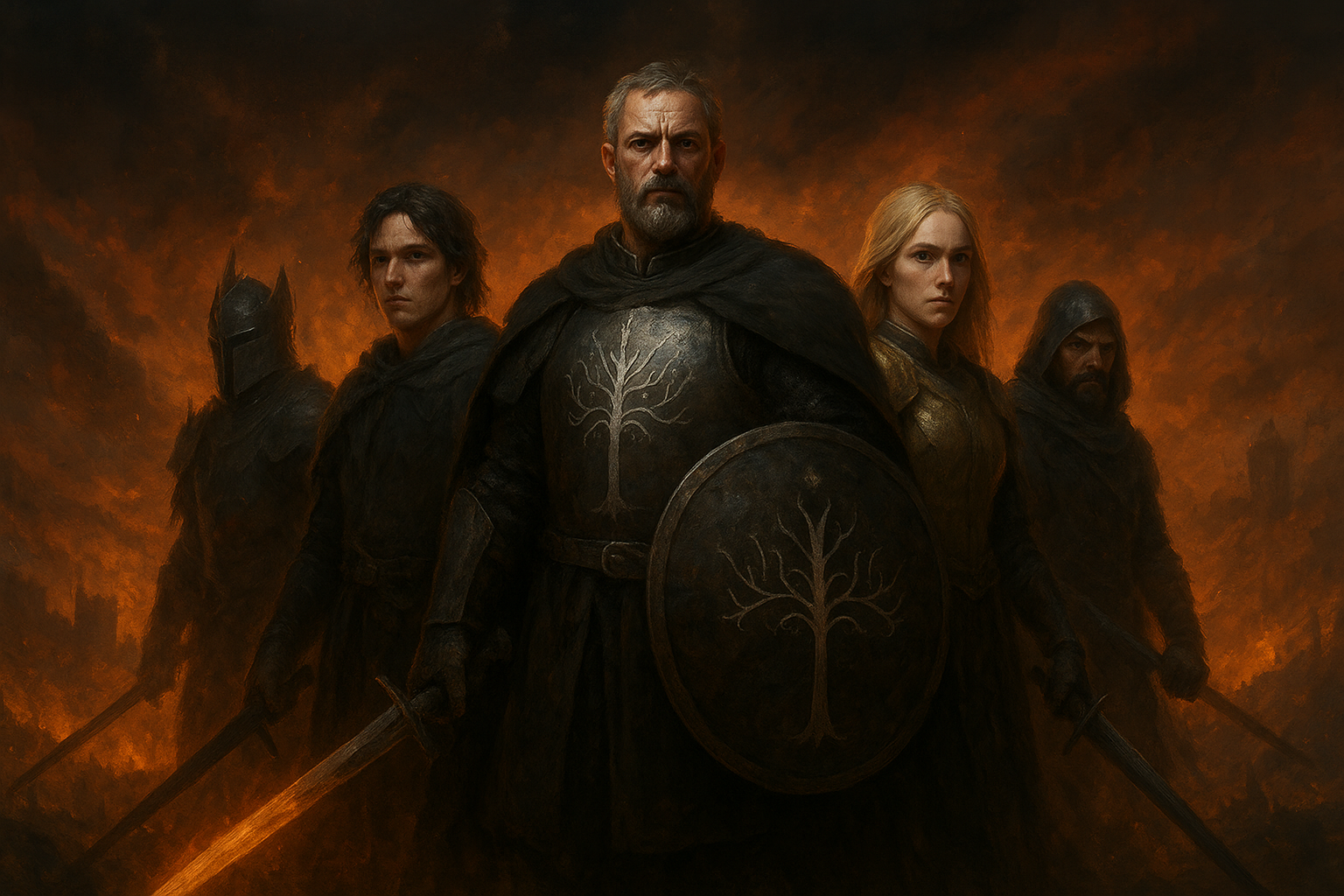
At their head, PAPPAS, Commander of Gondor, his shield battered yet unbroken.
Beside him, Emrys, flame in his eyes, bearing the blade that once belonged to his father.
From the west, three allies had come — bound not by oath, but by destiny: Beatrix Kiddo, her golden sword shimmering through the smoke; Origin, a master of twin blades, every movement precise as if time obeyed him; and KnightHunts, towering in black steel, each strike shaking the ground.
Below them, the Veiled One’s legions advanced — a sea of fire and shadow, the roar of orcs, the hiss of fell beasts.
The first horn sounded. PAPPAS lifted his shield and shouted,
“For Gondor! For the City of Kings!”
The ground trembled as the five descended into the heart of battle.
Beatrix was a storm of gold — her blade flashed faster than thought, each swing carving through darkness. Origin fought beside Emrys, moving in perfect rhythm — two forces of chaos that somehow found harmony.
KnightHunts roared, cleaving through waves of enemies, his armor cracked but his stance unyielding.
And Emrys… his sword burned with crimson flame, every strike driven by purpose — to protect, to endure, to light the dark.
Hours passed. The sky turned red from fire and blood.
Then the Veiled One appeared. A tower of black mist and steel, his voice like thunder:
“You fight in vain. Gondor will fall, and your names will fade.”
PAPPAS stepped forward, slamming his shield into the ground, the White Tree sigil gleaming through the soot.
“Then let them fade,” he growled, “but not before the world remembers how we burned.”
The clash that followed shook the walls of the City.
Beatrix’s golden sword shattered the Veiled One’s staff. Origin’s twin blades tore his armor apart. KnightHunts struck with both greatswords, driving the shadow to its knees.
Emrys, bleeding and exhausted, thrust his flaming blade into the Veiled One’s chest — a blinding light erupted, tearing through the darkness.
When the light faded, the field was silent. The enemy was gone.
Smoke curled into the morning air. The five stood among ruins — wounded, bloodied, but alive.
PAPPAS fell to one knee, gripping his broken shield. Emrys helped him stand.
“The flame still burns,” PAPPAS said, his voice weak but steady.
Emrys nodded. “Then we guard it — together.”
Beatrix sheathed her sword, a faint smile on her face. “Guess death will have to wait.”
Origin cleaned his blades in silence, his eyes on the dawn.
KnightHunts placed his gauntleted hand on Emrys’s shoulder. “The world’s not done with us yet.”
And as the first rays of sunlight touched the White City, the five stood together — weary, scarred, but unbroken.
That day, the people of Gondor spoke of The Fire and the Shadow —
not as the battle that ended,
but as the dawn of legends yet to come.
VI. The Dawn of the Five
The dawn came slow over Minas Tirith — not triumphant, but tender. Smoke still lingered over the ruins of Pelennor Fields, rising like silent ghosts of the fallen. Yet the White City still stood. Broken, battered, but unbowed.
In the courtyard of the Citadel, five figures gathered beneath the pale light of morning. The marks of war clung to their armor; blood, soot, and the silent weight of survival.
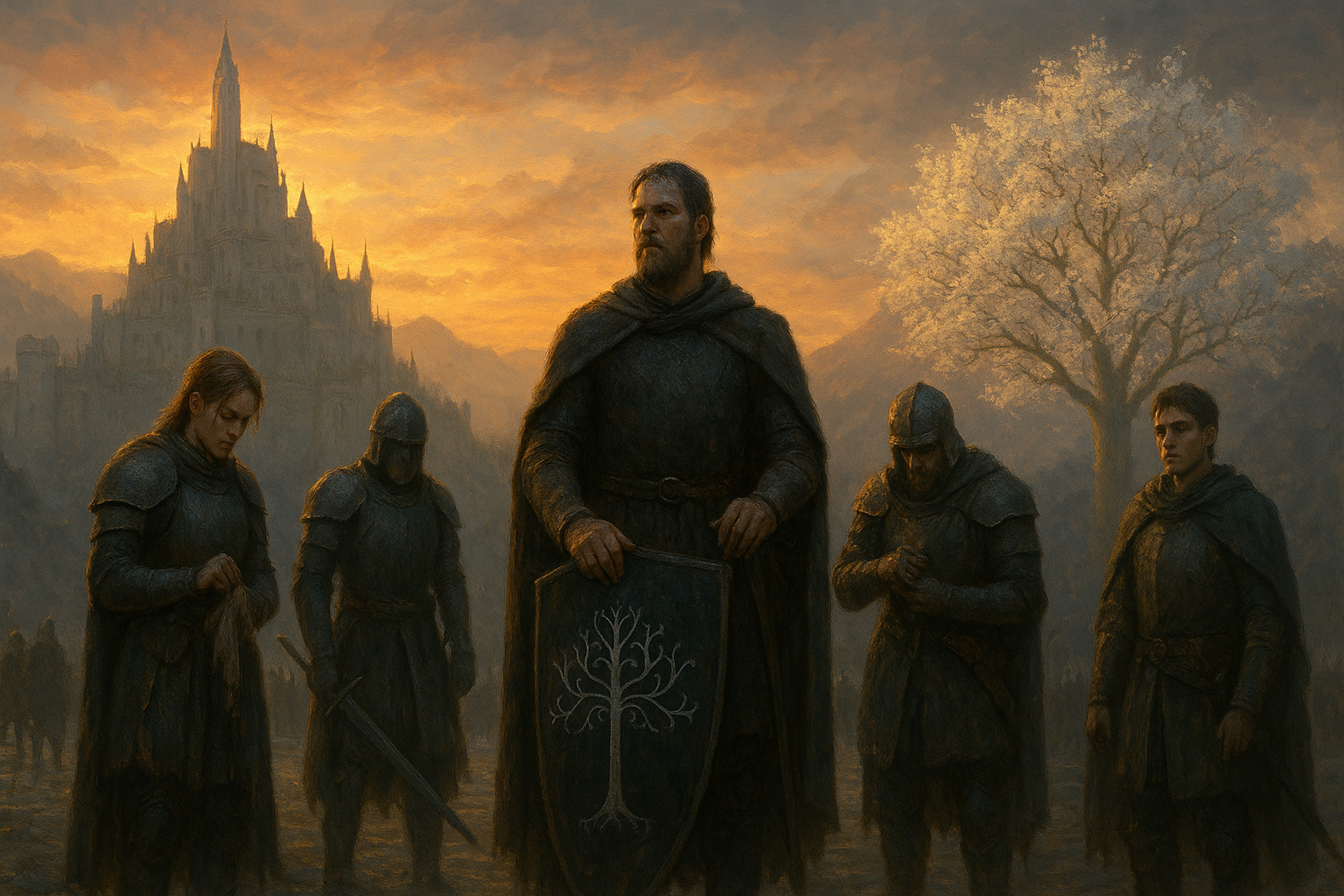
PAPPAS leaned on his shield, its White Tree scorched but visible. “We stood,” he murmured. “And for that alone, the City endures.”
Emrys looked toward the east, where the mountains met the sky. His face was calm, but his eyes burned with thought. “We won a battle,” he said quietly, “but the war isn’t done. Mordor’s shadow still breathes.”
Beatrix cleaned her golden blade with a torn cloth, her movements slow and deliberate. “Then let it breathe,” she said. “We’ll make sure it chokes on its own darkness when it dares to return.”
Origin stood apart from them, sharpening his twin blades in silence. The rhythm of metal on stone was like a heartbeat — steady, patient, waiting.
KnightHunts was repairing a piece of his cracked armor. “A city rebuilt needs more than walls,” he rumbled. “It needs people willing to believe again.”
PAPPAS turned to him. “And do you believe?”
KnightHunts paused, then nodded once. “I do now.”
For a long time, none of them spoke. The wind carried the scent of rain, and the first drops began to fall — washing blood from stone, soot from armor, pain from faces.
Emrys raised his hand, catching a raindrop in his palm. “Every drop,” he whispered, “is a life we didn’t lose. A promise we still owe.”
Beatrix smiled faintly. “Poetic as ever, flame-bearer.”
He looked at her and for a moment, the tension of war gave way to something softer — mutual respect, shared silence.
Then, from above the walls, a horn sounded — not the call of war, but the song of renewal. Gondor’s people were returning from the mountains, carrying wood, stone, and hope.
PAPPAS lifted his head. “The rebuilding begins.”
KnightHunts grinned beneath his helm. “Then let’s make sure they have something worth rebuilding.”
As the five turned toward the city, sunlight broke through the clouds — golden beams falling upon the White Tree, its branches glistening with dew.
And for the first time in many years, it bloomed.
The petals of the White Tree fell like snow upon them, and in that moment, they knew — the age of despair had ended.
A new era had begun.
And they — Emrys, PAPPAS, Beatrix, Origin, and KnightHunts — were its guardians.
VII. The Shadows of the East
Months had passed since the Battle of Pelennor’s Ashes. Gondor was healing — its walls rebuilt, its banners bright once more. But peace was a fragile illusion, like sunlight breaking through storm clouds that never truly left.
Emrys had spent many of those months in the archives beneath the Citadel, studying maps, prophecies, and the forbidden texts of Númenor. The White Tree had bloomed again, yes — but its petals sometimes fell black as soot. And that, he feared, was an omen.
One night, as the moon burned red above the White Mountains, PAPPAS entered the chamber. His armor was polished but his eyes were heavy.
“You haven’t slept,” he said.
Emrys didn’t look up. “Dreams offer no peace anymore.”
PAPPAS stepped closer, setting his shield against the table. “What do you see in those old scrolls?”
“Movement,” Emrys whispered. “East of Mordor. Beyond the Sea of Rhûn. Armies gathering under a banner we do not know.”
“Another war?”
“Not yet,” Emrys said softly. “But it’s coming.”
Far away, in the southern forges, Beatrix Kiddo trained a new legion — soldiers who fought not for kings, but for the living. Her sword, once golden, now bore faint scars that glowed faintly at dusk. She could feel it — darkness was stirring again.
Origin and KnightHunts had taken to patrolling the borders of Ithilien, hunting the remnants of orc tribes. But they noticed something strange — the orcs were no longer leaderless. They moved with discipline, with purpose.
And at night, the wind carried whispers in a forgotten tongue.
A name.
“Valandor.”
When Emrys heard it for the first time from a dying scout, he froze.
“That name…” he breathed. “It shouldn’t exist.”
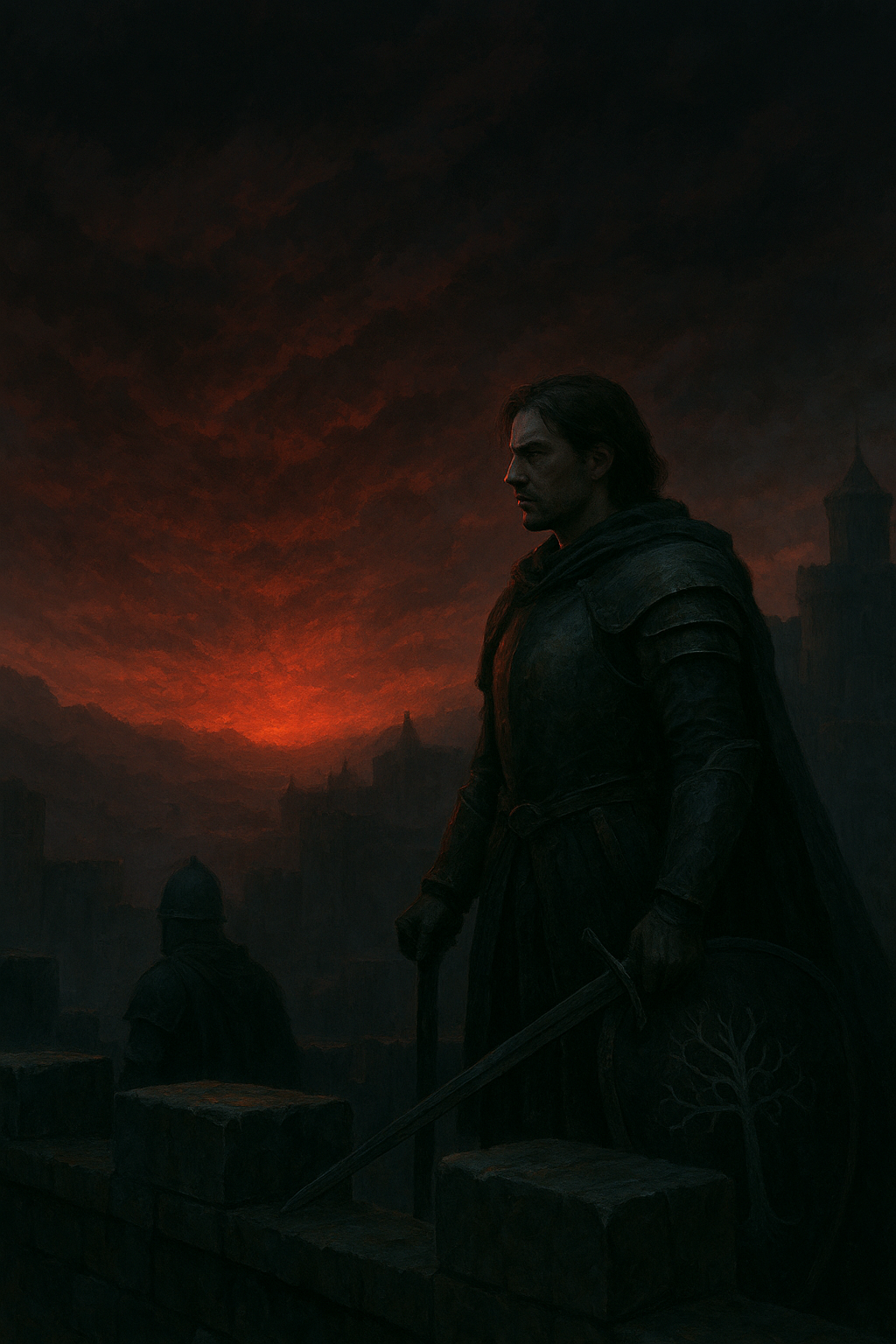
Later that night, he and PAPPAS met again on the walls of Minas Tirith, watching the moon fade into the mist.
“If this Valandor is real,” PAPPAS said grimly, “we’ll face something older than Sauron himself.”
Emrys nodded. “And darker. A remnant of Númenor’s pride… and its curse.”
He looked eastward.
There, far beyond sight, a crimson glow flickered on the horizon — not fire, not lightning, but something alive.
And for the first time since the war, Emrys felt fear.
VIII. The Rise of Valandor
The night trembled beneath a blood-red moon, and the air carried the scent of old ashes and forgotten oaths.
From the ruins of Barad Eithel, a shadow stirred—a presence long thought lost to time itself. The winds whispered his name through the broken towers and lifeless plains: Valandor.
Once, he had been the Guardian of the West—a warrior-scholar who sought balance between light and shadow. But power, as it always does, had demanded more. Betrayed by his own brethren, his body had perished… yet his spirit endured, buried beneath centuries of silence. Now, that silence was broken.
Dark storms rose across the lands of Gondor and Rohan. Beasts unseen since the First Age crawled from the earth. The rivers turned black beneath the moonlight. And in every city, the people dreamed of a man with eyes like dying stars—Valandor’s eyes.
Far to the west, in the halls of Minas Tirith, an ancient horn sounded once more. Emrys stood before the White Tree, feeling the tremor of fate beneath his feet. The world he had once known was fading, and only one truth remained:
Valandor had returned.
It was PAPPAS who first gathered the others. The old commander’s armor no longer shone, but his resolve had never dulled. Beatrix Kiddo came from the South, carrying scars and silence. Origin arrived with two blades and a heavy conscience, while Knighthunts emerged from exile, his twin swords gleaming like lightning.
They met beneath the ruins of Osgiliath—the ghosts of old wars still whispering in the stones.
“This time,” said Emrys, his voice calm but resolute, “we fight not for victory, but for remembrance.”
And as the first thunder rolled across the sky, they saw him.
Valandor descended upon them like a storm given flesh—his cloak a cascade of shadow, his voice echoing with the grief of gods.
“You think you can stop me again?” he said. “I am not vengeance. I am what remains when the light forgets itself.”
The battle that followed was chaos and symphony—a clash of faiths, histories, and wounds unhealed. Fire met steel, light met darkness, and for a brief moment, the world itself seemed to hold its breath.
No one died that night, but each carried a mark that would never fade. The war for the soul of Arda had begun anew.
IX. The Shadow of the Crown
The storm had passed, but the world did not feel cleansed — only quieter, as if the land itself was holding its breath. The battle at Osgiliath had left more scars than wounds; memories, doubts, and whispers of destiny clung to the five like shadows that would not fade.
Valandor had vanished into the East, his army of wraiths following like smoke, but his voice still echoed in their dreams.
"You cannot fight what is already within you," he had said, and even now, those words festered in their minds.
In the White City, Emrys stood before the empty throne of Gondor. The hall was silent except for the slow dripping of melted wax. Above him, the ancient crown rested on a black velvet cloth — its silver edges gleaming faintly in the half-light.
He reached out, not to wear it, but to feel the weight of it.
“Every king is born in light,” he murmured, “but crowned in shadow.”
PAPPAS entered, his armor still cracked from the battle.
“You’re thinking of him again,” he said.
Emrys didn’t deny it. “He was one of us once.”
PAPPAS’s jaw tightened. “Not anymore.”
Meanwhile, Beatrix trained alone in the courtyard, her blade singing through the air. She fought not enemies, but memories — the faces of those she couldn’t save. Origin, seated nearby, sharpened his twin swords in silence, each scrape echoing like a confession.
Knighthunts watched them from the walls, eyes narrowed beneath his hood.
“We are breaking,” he whispered to himself. “And he knows it.”
Far away, in the ruins of Minas Morgul, Valandor sat upon a throne of bone and black glass. His body shimmered between form and spirit.
“The crown,” he said softly, “was never meant to rule the living… but to bind their souls.”
He closed his hand, and somewhere in the West, the White Tree trembled.
X. The Last Light of Gondor
The White Tree was dying.
Its roots, once strong beneath the stones of Minas Tirith, now trembled in silence. The petals that had glowed with silver light were falling like pale tears into the wind. No priest, no healer, no magic could revive it — because it was not only a tree. It was Gondor’s memory, and memories, once lost, seldom return.
Emrys stood before it at dawn, the first rays of sunlight cold and colorless. His hand brushed the bark — it felt brittle, hollow, almost afraid.
In the reflection of the marble floor, he saw himself not as a boy of Gondor, but as something older, something bound to the same fate as the tree.
Valandor’s shadow had reached even here. His whispers slithered through the cracks of the city, filling hearts with doubt and dreams with fire.
"The light is not gone," he had said once, "it has simply forgotten you."
PAPPAS gathered the others in the Hall of Kings. “If the Tree dies,” he said, “then Gondor dies with it. And if Gondor dies, the West will fall.”
Beatrix rested her blade against the wall. “Then we keep it alive — or we burn with it.”
Origin said nothing. His eyes were fixed on the ground, as though he was listening to voices none of them could hear.
Knighthunts finally spoke, voice hoarse from silence. “He’s drawing power from the Tree. That’s why it fades. He doesn’t want Gondor destroyed… he wants it hollowed.”
Emrys turned toward them. “Then we cut him off — even if it means cutting into the roots of the world itself.”
Far away, in Minas Morgul, Valandor raised his hands toward a pale, pulsing crystal. Inside it shimmered the faint image of the dying Tree.
“Their world is not ending,” he whispered. “It is returning to its truth — to shadow.”
As his power grew, the sky over Gondor dimmed. The White Tree’s last bloom quivered, struggling to hold its light. Emrys closed his eyes, and for the first time, he prayed — not for victory, but for remembrance.
The wind carried his whisper across the land:
“Even in shadow… light remembers.”
|


 The character of [ Emrys ]